Analytics ·
Offline Conversion Tracking in Digital Marketing
How to connect online ad interactions with offline sales for complete marketing attribution and better ROI measurement.
By Abhay Sharma
Most customer interactions start online but often conclude offline. This is common for products like cars, real estate, or complex software solutions, where buyers typically prefer offline engagements like in-person meetings, test drives, or product demos. Offline conversion tracking bridges this gap by linking digital marketing efforts with offline sales actions, giving marketers a complete picture of campaign effectiveness.
Understanding Offline Conversion Tracking
Offline conversion tracking connects digital ads to sales made outside the online environment. When users interact with digital ads and convert offline—such as purchasing at a physical location or finalizing a contract through direct contact—the offline event can still be linked back to the digital ad interaction. This ensures accurate performance measurement and more effective campaign optimization.
Importance for Marketers
Marketers often measure success through online metrics alone, such as leads or clicks. But in industries like automotive or SaaS, most meaningful conversions happen offline. By tracking these offline outcomes, marketers can accurately assess the true return on investment (ROI) and better allocate their marketing budgets.
Real-Life Example: SaaS Company Scenario
Consider a SaaS company selling a complex enterprise solution. A potential customer clicks on an online ad, visits the website, and fills out a lead form to request a product demo. After multiple sales calls, meetings, and discussions over weeks, the customer finally signs a contract offline.
Without offline conversion tracking, the marketing team would only see a lead form submission—not the sale itself. By implementing offline conversion tracking, they can link the digital ad interaction directly to the offline sale. This allows the marketing team to optimize campaigns based on true conversions, not just online interactions.
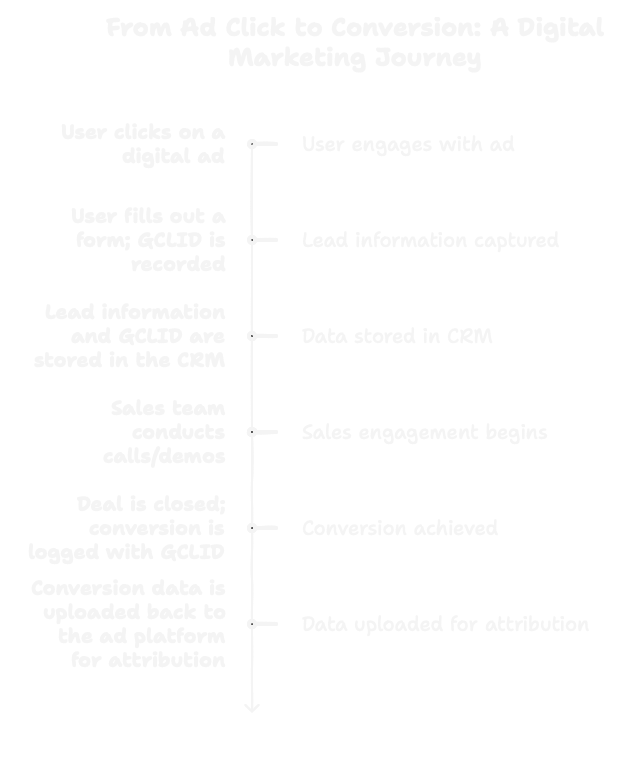
How Does Offline to Online Matching Work?
Offline conversion tracking involves two key steps:
1. Capturing a Common Identifier
- Platforms like Google Ads and Meta Ads use unique identifiers called Click IDs (such as GCLID for Google and FBCLID for Meta).
- When users click on an ad, these platforms generate a unique Click ID and pass it to the landing page.
- Websites capture and store this Click ID along with user data (like form submissions) into a Lead Management System (LMS) or CRM.
2. Uploading Conversion Data Back to Platforms
- When an offline conversion occurs (such as a sale), the sales data and corresponding Click ID are uploaded back to Google or Meta via methods like Sheets, HTTPS uploads, or direct CRM integrations.
- The platforms match this Click ID to the original ad click, attributing offline sales to specific digital campaigns.
Changes in Google Ads: Enhanced Conversions for Leads (ECL)
Previously, Google relied solely on Click IDs for offline tracking. However, recent privacy-focused browser updates (like Safari's Intelligent Tracking Prevention) have blocked Click IDs from being captured reliably.
Google responded by introducing Enhanced Conversions for Leads (ECL). Here's how it works:
- When a user submits a lead form online, the lead's contact information (email or phone number) is securely hashed and sent to Google.
- Upon conversion (such as a contract signed offline), the company uploads hashed versions of the same contact details to Google.
- Google matches the hashed contact information from the initial lead form to the offline conversion event.
This method, although simpler, matches conversions at the lead level rather than the more granular click/session level, which was possible using Click IDs.
Implementation Best Practices
To implement offline conversion tracking effectively:
- Update form submissions: Ensure all landing pages and forms capture Click IDs and pass them to your CRM or lead management system.
- Train sales teams: Sales representatives must accurately record conversion data along with corresponding identifiers.
- Automate where possible: Set up integrations between your CRM and advertising platforms to automatically upload conversion data.
- Verify data quality: Regularly audit your offline conversion tracking to ensure accuracy and completeness.
Conclusion
Offline conversion tracking is essential for accurately measuring campaign effectiveness in industries where conversions typically occur offline. By implementing proper tracking methods and uploading conversion data back into digital platforms, marketers gain better insights, make smarter decisions, and ultimately achieve higher ROI.